
Table of Contents
- What Digital Dental Technology Actually Changes for Patients
- Digital Dental Impressions vs Traditional: Comfort, Accuracy and Time
- Digital Smile Design Benefits: Planning the Result Before Treatment Starts
- How Long Do Digital Dental Implants Take, and Why Planning Changes the Timeline
- Fewer Appointments and Less Discomfort: What the Digital Workflow Delivers
- Common Concerns About Digital Dentistry, Addressed Honestly
- Frequently Asked Questions
Last Updated: September 27, 2026
What Digital Dental Technology Actually Changes for Patients
Digital dental technology is the use of intraoral scanning, 3D imaging and software-based planning to design and deliver dental treatment, replacing manual impressions and guesswork with a visible, measurable plan. At Aviva Cosmetic Dentistry, we use a fully digital workflow that means greater comfort, fewer appointments and predictable results.
The benefits of digital dental technology are easiest to understand by contrast. Traditional dentistry often asked you to trust a description. Digital dentistry shows you the plan.
The tools themselves are less important than what they replace.
The Core Tools Used in a Digital Workflow
An intraoral scanner captures the shape of your teeth and gums as a 3D model, replacing the tray of impression putty. Cone beam CT imaging gives a three-dimensional view of bone, roots and nerve positions. Design software lets a clinician plan a crown, veneer or implant position on screen, and in-house milling or printing produces the restoration from that plan.
Each tool feeds the next. The scan informs the design; the design guides the placement. That chain is what makes outcomes more predictable than working from a physical mould and a written note.
Digital Dental Impressions vs Traditional: Comfort, Accuracy and Time
Digital impressions are more comfortable, generally more accurate and faster to take than traditional impressions. A scanner wand passes over the teeth in a few minutes and the model appears on screen immediately, so the clinician can rescan any area that needs it before you leave the chair.
Traditional impressions involve a loaded tray held in place while the material sets, which many patients find uncomfortable, particularly those with a strong gag reflex. The mould is then posted to a laboratory, and a poor cast may mean a remake and a second appointment.
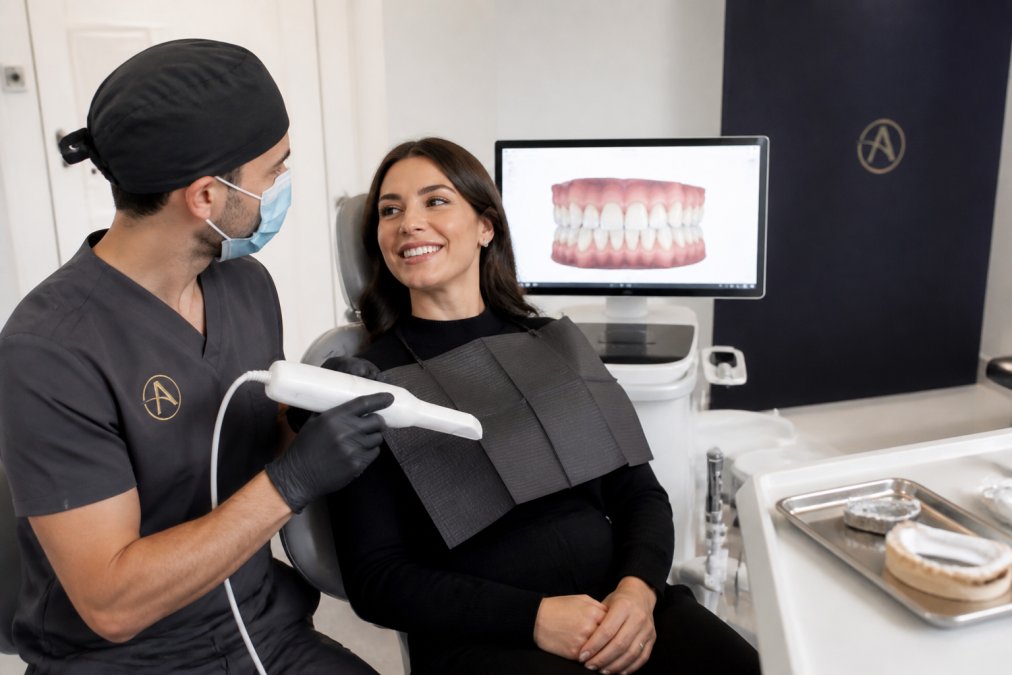
The practical differences matter more than the marketing language:
| Factor | Digital impressions | Traditional impressions |
|---|---|---|
| Comfort | Scanner wand, no tray | Loaded tray held in place |
| Chair time | A few minutes | Several minutes setting |
| Accuracy check | On screen, immediately | At the laboratory |
| Remakes | Rescan on the spot | New appointment likely |
| Record | Stored digitally | Physical cast |
A common mistake is assuming digital scanning is only about comfort. The bigger gain is that errors are caught while you are still in the chair, not days later.
Digital Smile Design Benefits: Planning the Result Before Treatment Starts
Digital smile design is the process of planning a smile on screen, using photographs, scans and facial measurements, before any treatment begins. The main benefit is that you can see and discuss the proposed result in advance, and adjust it while changes are still free.
This is where digital planning earns its place in cosmetic work. Instead of describing a shade or a shape, the clinician can show you the proposed proportions against your own face and bite. If a tooth needs to move, the plan shows where. If a veneer is too long, you can see it before it is made.
What most guides miss is that the value is not the software. It is the conversation the software forces. A plan you can see is a plan you can question, and that is exactly when questions should be asked.
Ask to see the proposed design against a photograph of your own face, not a generic model. The proportions that suit one face shape often look wrong on another.
::: (Source: NHS Digital’s work on digital transformation in healthcare)
How Long Do Digital Dental Implants Take, and Why Planning Changes the Timeline
The timeline for dental implants depends on healing, bone condition and whether grafting is needed. The planning stage, done digitally, does not usually lengthen the process. It often shortens it by reducing surprises.
An implant is a post placed into the jawbone to support a crown, bridge or full-arch restoration (Dental Implants). Digital planning lets the clinician assess bone volume and nerve position in three dimensions, then place the implant according to that plan, often using a printed surgical guide.
Where the timeline genuinely varies is healing. The bone must integrate with the implant before it can bear a final restoration, and that process follows biology, not scheduling. Digital planning cannot rush it, but it can prevent the delays caused by an implant placed at a less than ideal angle.
If you are working towards a fixed date, such as a wedding, the honest answer is that the plan matters more than the deadline. A consultation with imaging will tell you what is realistic far better than a general estimate.
Fewer Appointments and Less Discomfort: What the Digital Workflow Delivers
A fully digital workflow usually means fewer appointments and less discomfort across a course of treatment. Scanning, designing and, where appropriate, producing a restoration in-house removes several of the steps that traditionally required separate visits.
For patients with busy schedules, this is often the deciding factor. Fewer visits also mean less time in the chair, which matters if you find dental appointments difficult. At Aviva Cosmetic Dentistry, we plan treatment around the whole patient and work to keep appointments unhurried, because a calm, well-planned visit is easier on nervous patients than a quick one.
The gains are real but not unlimited. Complex full-mouth rehabilitation still takes multiple visits, and anyone who promises a single appointment for extensive work is overselling.
Be sceptical of any practice that promises a fixed number of appointments before it has scanned and assessed you. The honest number comes after the imaging, not before.
Common Concerns About Digital Dentistry, Addressed Honestly
Digital dentistry does not remove the need for clinical judgement, and it does not guarantee a result. It is a set of tools that make planning and execution more precise, and precision reduces the risk of remakes and adjustments. It does not eliminate them.
Concerns patients raise most often tend to be practical rather than technical. Will the result look natural? How many visits will it take? What happens if something needs adjusting later? These are fair questions, and they are best answered after an assessment rather than in general terms.
On natural-looking results: shade, translucency and tooth shape are chosen with you, and digital design lets those choices be tested on screen first. On longevity: restorations and implants are subject to wear, bite forces and hygiene, so how long they last depends on the case and on how well they are maintained. On aftercare: ask directly what the practice’s approach is if something needs revisiting, and get the answer before treatment starts.
A second opinion is never a waste of time. If a plan cannot be shown to you clearly, that is worth knowing.
Digital tools improve planning and precision. They do not replace the assessment, the conversation or the aftercare, and any practice that presents them as a shortcut around those is telling you something useful.
Choosing a practice for implant or cosmetic work comes down to more than the equipment list. The planning, the clinical judgement behind it and the care taken over the details are what determine how a result looks and how long it lasts. Aviva Cosmetic Dentistry combines a fully digital workflow with unhurried, personalised assessment, minimally invasive techniques and a focus on oral health as the foundation for any cosmetic result. If you want a plan you can see and understand before committing to treatment, book your consultation now and we will talk you through exactly what is possible in your case.
Frequently Asked Questions
What are the main benefits of digital dentistry for patients?
Digital dental technology replaces putty trays and guesswork with 3D scans, software planning and precision manufacturing. For patients, this means more comfortable appointments, a clearer view of the proposed result before treatment begins, and restorations that fit accurately because they are designed from a digital model of your own teeth. It also reduces the need for repeat visits, since problems can be spotted and corrected in the planning stage rather than after a crown or implant is already made.
How does digital dental technology improve treatment accuracy?
Intraoral scanners capture thousands of data points per second, building a 3D model of your mouth that is far more detailed than a putty impression. That model feeds directly into design software and, for implants, into guided surgery planning. The result is a restoration or implant position planned to fractions of a millimetre, rather than estimated by eye. This level of accuracy is one reason digital workflows produce more predictable outcomes, particularly for complex cases involving multiple teeth.
Is digital dentistry safer than traditional methods?
Digital tools do not replace clinical judgement, but they do reduce some common sources of error. Scans remove the gag reflex and messy putty associated with traditional impressions, and guided implant placement uses your own scan data to plan depth and angle in advance. That said, every treatment carries some risk, and outcomes depend on the skill of the clinician and the health of your mouth. A thorough assessment before treatment remains the most important safety step.
How does digital technology reduce the number of dental appointments?
Traditional workflows often need one visit for impressions, another for a try-in and a third for fitting, because each stage depends on a physical model being posted between the practice and the lab. Digital scans are sent electronically, so the lab can begin work immediately. For treatments like crowns or aligners, this frequently removes one or two visits. Implant cases still need healing time between surgical stages, but the planning and restoration phases involve fewer trips.
