
Table of Contents
- What Digital Dentistry Workflows Actually Change
- Intraoral Scanning Benefits: Comfort, Speed and Accuracy
- The Digital Smile Design Process: Planning Before Treatment Starts
- Patient Experience in Digital Dentistry: Fewer Appointments, Calmer Visits
- Where Digital Workflows Make the Biggest Difference
- Limits and Considerations of Digital Dentistry Workflows
- Conclusion
- Frequently Asked Questions
Last Updated: September 28, 2026
What Digital Dentistry Workflows Actually Change
Digital dentistry workflows replace impression trays, plaster casts and guesswork with intraoral scanning, 3D imaging and software that plans treatment before a single instrument touches a tooth. At Aviva Cosmetic Dentistry, we use this approach daily, and it changes three things: how accurately we can see what is happening in your mouth, how predictable the final result becomes, and how many visits it takes to get there. (Source: General Dental Council standards for dental professionals)
The shift is not cosmetic. It is diagnostic.
A conventional workflow records the mouth in two dimensions and interprets the rest. A digital one captures the full arch in three dimensions, stores it, and lets the clinician rotate, measure and simulate against it. That difference matters most in complex restorative cases, where small errors compound over multiple teeth.
General Dental Council standards for dental professionals set the expectations for record keeping and patient consent that any digital workflow must still meet. The technology changes the method, not the obligations.
Here is what that looks like in practice, section by section.
Intraoral Scanning Benefits: Comfort, Speed and Accuracy
The main intraoral scanning benefits are comfort, speed and accuracy: a small handheld wand captures the whole arch in minutes, with no tray, no setting material and no gag reflex. Most patients describe it as unremarkable, which is the point.
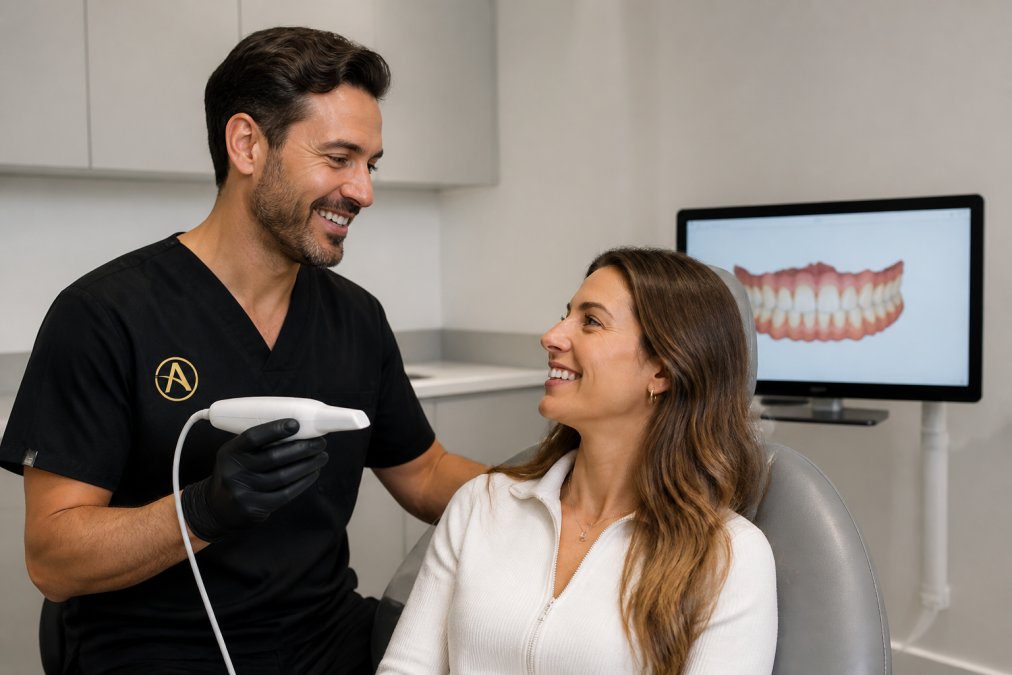
The scan is also re-scannable. If a margin is unclear, the clinician rescans that area immediately rather than repeating the whole impression. Nothing is lost to a distorted tray or a bubble in the material.
How Scanning Compares With Traditional Impression Trays
| Factor | Traditional impression tray | Intraoral scan |
|---|---|---|
| Comfort | Material sits in the mouth for minutes | Small wand, no material |
| Gag reflex | Common | Rare |
| Rework | Repeat the whole impression | Rescan one area |
| Storage | Physical cast, can chip | Digital file, archived |
| Fit checks | Lab stages between visits | Software checks before milling |
A common mistake is assuming a scan is only as good as the scanner. It is only as good as the clinician operating it. Margin detection, retraction and moisture control still decide whether a crown fits, whatever the hardware costs.
Ask to see your own scan on screen. Seeing the 3D model of your teeth is often the moment nervous patients relax, because the problem stops being abstract and starts being something you can point at.
The Digital Smile Design Process: Planning Before Treatment Starts
The digital smile design process plans the outcome before treatment begins, using photographs, scans and facial measurements to build a proposed result in software. The clinician and patient review that plan together, adjust it, and only then commit to treatment.
This is the part most people find genuinely different from previous dental experiences. You are not asked to imagine the result. You are shown it.
Trying the Result Before It Is Made
A trial smile or mock-up lets you wear a temporary version of the proposed design, usually for a short period, so you can judge shape, length and proportion in your own face rather than on a screen. If the proportions look wrong when you smile in a mirror, we change the plan, not the tooth.
That sequence matters for anyone who has been burned before by restorations that looked bulky or too white. Design decisions get made while they are still reversible. (Source: research on the adoption of digital technologies in UK dental practices)
Skipping the mock-up stage is where natural-looking results go wrong. If a plan is approved only on screen, small proportion errors are far harder to correct once the final restorations are made.
Patient Experience in Digital Dentistry: Fewer Appointments, Calmer Visits
The patient experience in digital dentistry comes down to fewer appointments and calmer visits. Scans replace impressions, digital records move between clinician and laboratory instantly, and fit is verified in software rather than by posting casts back and forth.
For anyone commuting in and out of St Albans, that compression is practical. Fewer trips, shorter chair time, and less of the waiting that comes from a lab stage going wrong.
Anxious patients tend to benefit most. There is no tray in the mouth, no setting material to tolerate, and no surprise about what happens next because the plan was reviewed in advance. Unhurried appointments help as well. Nervousness rarely responds to speed.
NHS information on dental anxiety and treatment options notes that fear of dental treatment is common and manageable, which is worth remembering if previous experiences have put you off.
Where Digital Workflows Make the Biggest Difference
The biggest gains show up in complex, multi-tooth cases: implants, full mouth rehabilitation and anything involving a bite that needs rebuilding. Where a single filling is concerned, digital planning adds little. Where several teeth, the bite and the gum line all interact, it changes the outcome.
Digital records also make the whole process easier to coordinate. Scans, photographs and design files sit in one place, so a prosthodontist, an implant surgeon and a laboratory work from the same data rather than from separate impressions of the same mouth.
For patients, that reduces the risk of being passed between specialists who each start from scratch.
Limits and Considerations of Digital Dentistry Workflows
Digital workflows are not a substitute for clinical judgement, and they do not suit every situation. Scanners struggle with deep subgingival margins, heavily restored mouths and areas where moisture cannot be controlled. In those cases, a conventional impression may still be the better route.
Cost is a fair consideration. Pricing varies by case complexity, so it is worth asking for a written plan and quote rather than a headline figure.
There is also a learning curve. A clinician who has not been trained properly on the software will produce a digital plan no better than a conventional one. The technology amplifies skill; it does not replace it.
The clearest sign of a well-run digital workflow is not the scanner on the counter. It is whether you were shown a plan, a mock-up and a clear explanation before treatment started.
Conclusion
The real challenge with digital dentistry is not the equipment, it is finding a practice that uses it as part of a considered, health-first approach rather than as a marketing feature. At Aviva Cosmetic Dentistry, our internationally renowned clinical team combines state-of-the-art digital technology with a fully digital workflow, minimally invasive techniques and unhurried, personalised care in the heart of St Albans. If you want a result planned before it is made, with fewer appointments and predictable outcomes, book your consultation now.
Frequently Asked Questions
What is a digital workflow in dentistry?
A digital workflow replaces traditional putty impressions, physical models and hand-written lab instructions with digital tools. An intraoral scanner captures a 3D image of your teeth, software plans the treatment, and the file is sent electronically to a laboratory or milling unit. Because every stage shares the same digital file, the result you approve on screen is the result that gets made, which reduces the errors that come from moulds, casts and manual measurements.
Are digital dental impressions more accurate than traditional ones?
For most crown, veneer and implant cases, intraoral scans capture the preparation and surrounding teeth more consistently than impression trays. There is no setting material to distort, no tray to shift and no bubbles to spoil the margin. Scans can also be reviewed immediately, so if a margin is unclear the dentist rescans straight away rather than asking you back for a second impression appointment. Accuracy still depends on the clinician’s technique and on keeping the scan area dry.
How does digital technology reduce the number of dental appointments?
Traditional workflows often need one visit for impressions, another for a try-in and a third for fitting, because each stage depends on a physical model travelling between surgery and laboratory. Digital files move instantly, and restorations can be designed and milled while you wait in some cases. For implant and full-mouth cases, guided surgery based on a scanned plan can also combine stages that would otherwise be separate procedures, which matters if you are fitting treatment around a busy working week.
How does digital dentistry improve patient comfort?
The most obvious gain is that the impression tray is gone. Many people find the gag reflex and the taste of impression material the worst part of dental treatment, and a scanner avoids both. Digital planning also means fewer repeat visits, shorter chair time and a calmer, more predictable experience. For anxious patients, seeing the scan and the proposed result on screen before anything begins often makes the treatment feel more controlled and less of a surprise.
