
Last Updated: October 31, 2026
Quick Summary
Bespoke cosmetic dentistry is treatment planned around your own teeth, bite, gum health and facial proportions rather than a standard package. At Aviva Cosmetic Dentistry, we assess and stabilise your oral health first, then plan the appearance phase digitally so you can approve the result before any tooth is touched.
- Enamel thins with age, letting the yellow tone of the dentine show through.
- We address decay, gum disease and failing restorations before discussing any veneer.
- Digital smile design lets you approve tooth shape and proportion before treatment begins.
- Whiten before any colour-matching work, or new restorations will be matched to teeth about to change shade.
- Aligning teeth first with clear aligners or fixed appliances often means less drilling and thinner veneers or none at all.
Table of Contents
- Why Bespoke Cosmetic Dentistry Suits Women Over 40
- The Assessment That Comes Before Any Treatment
- Digital Smile Design: Planning the Result Before Touching a Tooth
- Professional Teeth Whitening and Composite Bonding
- Dental Implants for Women Over 40: Replacing What’s Missing
- Full Mouth Rehabilitation: When Several Treatments Are Needed
- What a Bespoke Smile Makeover Costs and How to Plan It
- Book a Bespoke Cosmetic Dentistry Consultation
- Frequently Asked Questions
Why Bespoke Cosmetic Dentistry Suits Women Over 40
Bespoke cosmetic dentistry is treatment planned around one person’s teeth, bite, gum health and facial proportions rather than a standard package applied to everyone. At Aviva Cosmetic Dentistry, we build every plan this way because the mouth at 45 is not the mouth at 25.
How Oral Health Changes After 40
Enamel thins with age, which lets more of the dentine’s yellow tone show through. Gums recede, exposing darker root surfaces (Periodontal surgery). Years of acid exposure and old restorations leave hairline cracks and worn edges. Hormonal shifts around the menopause can leave gums drier and more reactive, so inflammation shows up faster and settles more slowly. None of this means your teeth are failing.
That distinction runs through everything below. Cosmetic work placed on inflamed gums or an unstable bite tends to chip, stain at the margins and need replacing. Healthy foundation first, appearance second: that order is the whole argument.
The Assessment That Comes Before Any Treatment
A proper assessment starts with a full examination of every tooth, the gums, the bite and the jaw joint, supported by digital scans and radiographs where they are clinically justified.
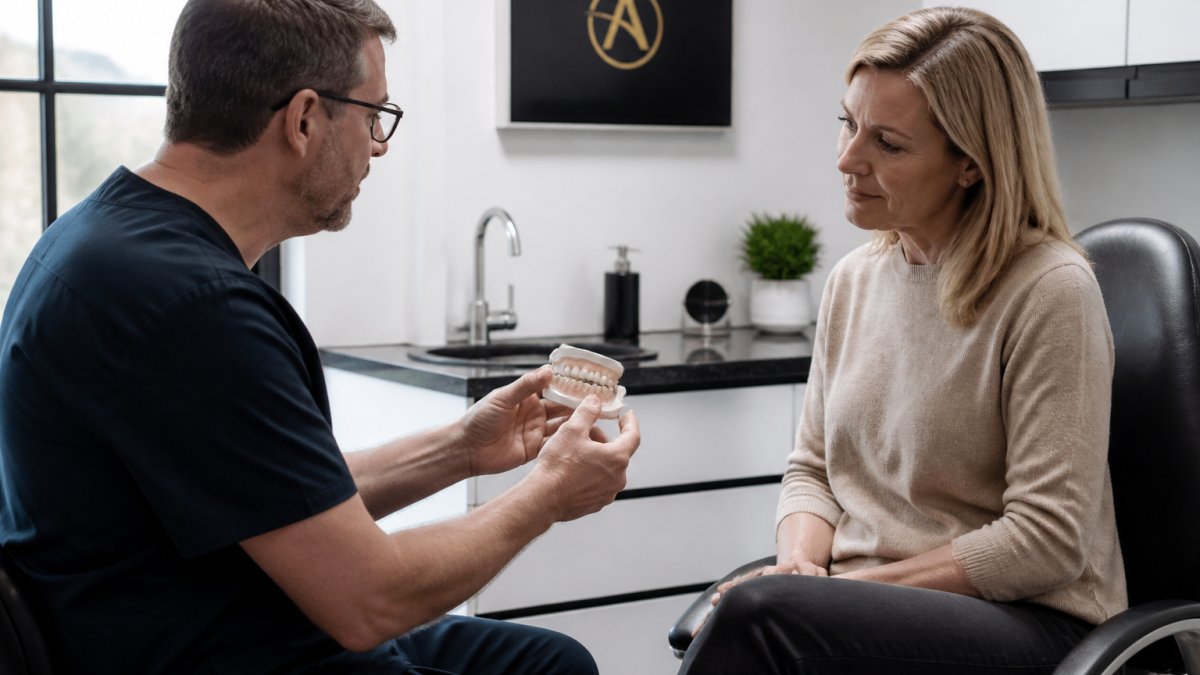
We look for active decay, gum disease, failing crowns or fillings, cracked teeth and any source of infection. Those get addressed before a single veneer is discussed.
Bring your questions. Nervous patients often arrive with a list, and that list is useful clinical information.
Digital Smile Design: Planning the Result Before Touching a Tooth
Digital smile design is the process of planning tooth shape, length and proportion digitally before any treatment begins, so you can see and approve the intended result in advance.
The practical benefit is conversation. You can look at a proposed design and say “that lateral incisor is too long” while it is still a file, not a finished tooth.
To see how this digital workflow shapes planning and comfort at our practice, read more about digital dentistry.
Professional Teeth Whitening and Composite Bonding
Most cosmetic plans for this age group are built from a small set of treatments, chosen in a deliberate order. The order matters more than the individual procedures, because whitening, bonding, veneers and orthodontics interact, and doing them in the wrong sequence is how people pay twice.
Whitening first, almost always
Professional teeth whitening lifts staining from the tooth structure under clinical supervision. It works on natural enamel and existing composite; it does not change the colour of crowns or porcelain veneers.
A common pattern after 40 is that teeth look duller not because of surface stain but because enamel has thinned and the dentine beneath shows through. Whitening still helps, but the improvement is more modest than a younger patient might expect, and over-whitening to chase a shade the enamel cannot hold leads to translucency and sensitivity.
Composite bonding: the minimally invasive option
Composite bonding is the direct application of tooth-coloured resin, shaped by hand and light-cured, to rebuild chipped edges, close small gaps or mask worn corners. It usually needs no drilling and can be added to rather than cut back.
The trade-off is honest: composite stains and wears faster than porcelain, may need polishing every couple of years and refreshing sooner, and is more technique-sensitive, the skill of the clinician shaping it by hand matters enormously.
Porcelain veneers: when the enamel is already compromised
Veneers are thin ceramic shells bonded to the front of teeth. While veneers address the structural integrity and brightness of the smile, balancing these dental refinements with the surrounding facial architecture often involves considering how dermal fillers can restore lost volume and support the lower face.
This is the trade-off that deserves the most careful conversation for women over 40. Where teeth are heavily worn, already heavily restored or badly discoloured, veneers may be the more predictable long-term choice. Where teeth are largely intact, bonding preserves options. Neither is universally right, and any practice that recommends the same one to everyone is not assessing you.
Adult orthodontics: straightening before masking
Many women in this age group have crowding or a shifting bite that has developed slowly since their twenties. Aligning teeth first, with clear aligners or fixed appliances, often means less drilling, thinner veneers or none at all, because the teeth no longer need to be disguised. Alignment also makes cleaning easier, which matters for gum health at an age when recession is already a risk.
Adult orthodontics is slower and less forgiving than in adolescence, and underlying gum disease must be stable before teeth are moved.
Ask any clinician to explain, tooth by tooth, why they are recommending a reversible treatment (whitening, bonding, aligners) over an irreversible one (veneers, crowns). If the answer is the same for every tooth, get a second opinion.
::: (Source: the growing demand for cosmetic dental treatments)
You can read about professional teeth whitening and composite bonding as separate treatments before deciding which fits your goals.
Dental Implants for Women Over 40: Replacing What’s Missing
Dental implants are titanium posts placed in the jawbone to support a crown, bridge or full arch, replacing a missing tooth root rather than resting on neighbouring teeth. After 40, gum health and bone volume need assessing properly, and any inflammation must be resolved first.
A gap is not only cosmetic. Neighbouring teeth drift, the opposing tooth over-erupts, and the bite changes. Replacing a missing tooth early is often simpler than rebuilding around a collapsed bite later.
If you are weighing up options for missing teeth, our dental implants page sets out the treatments we provide.
Full Mouth Rehabilitation: When Several Treatments Are Needed
Full mouth rehabilitation is a coordinated plan that rebuilds the bite and appearance across most or all teeth, combining implants, crowns, bonding and sometimes orthodontics in a single sequence.
Watch out: the biggest mistake is accepting a piecemeal plan, one tooth fixed here, another there, with no overall design. That is how people end up bounced between specialists and paying twice.
One clinician should own the plan and the sequence, even where specialists contribute.
What a Bespoke Smile Makeover Costs and How to Plan It
Pricing for bespoke cosmetic dentistry depends on what is being done, how many teeth are involved and whether health issues need treating first. For current prices or a quote, please visit the Aviva Cosmetic Dentistry website.
What drives the figure is predictable, though, and worth understanding before you sit down:
- How many teeth are involved. A single bonded edge is a different undertaking from ten veneers or a full arch.
- The material. Composite is generally less costly than porcelain, but needs refreshing sooner, so the cheaper option up front is not always cheaper over ten years.
- Whether a health phase comes first. Gum treatment, replacing failing fillings or resolving infection adds cost and time, but skipping it is what makes cosmetic work fail early.
- Whether orthodontics is needed. Aligning teeth before restoring them can reduce the amount of drilling and the number of restorations, sometimes offsetting much of its own cost.
- Laboratory and clinician time. Complex, hand-layered ceramic work and full-mouth reconstruction take longer to plan and make.
Planning the sequence
| Stage | What happens | What it decides |
|---|---|---|
| Assessment | Examination, scans, health check | Whether treatment is safe to start |
| Planning | Digital design, written plan | Sequence, stages and cost |
| Health phase | Gum treatment, decay, infections | Stability of the result |
| Alignment (if needed) | Clear aligners or fixed appliances | How conservative the aesthetic phase can be |
| Aesthetic phase | Whitening, bonding, veneers, implants | Final appearance |
| Maintenance | Hygiene visits, reviews | How long it lasts |
Finance and paying in stages
Because treatment is staged, payment usually is too. Ask about the payment and finance options available alongside your treatment plan, including the total payable.
The ten-year maintenance roadmap
Long-term maintenance plays a large part in how long a result lasts.
- Daily: clean between the teeth every day, interdental brushes or floss, because the margins of any restoration are where plaque collects first. Use a fluoride toothpaste and do not brush immediately after acidic food or drink (Oral health).
- Every six months (or as advised): professional hygiene, plus a review of margins, bite and gum health. Early staining at a veneer edge or a slightly high bite is cheap to correct and expensive to ignore.
- Every few years: composite may need polishing or partial replacement; porcelain generally holds longer but should still be reviewed. Night-time grinding is the single biggest threat to any cosmetic work, so a night guard is often part of the plan.
- Ongoing: hormonal changes continue after the menopause, so gum monitoring stays important for life. Bone density changes can affect implant maintenance, which is one reason implants need reviewing rather than assuming they are permanent.
A well-planned smile makeover is not a purchase you finish paying for and forget. It is a maintenance relationship, and the practices that are honest about that are the ones whose work still looks right ten years later.
For transparent pricing and finance information, see our fees.
Book a Bespoke Cosmetic Dentistry Consultation
We would rather spend an unhurried appointment examining, scanning and listening than rush you toward a treatment list. Our team includes Dr Brindha Karthikeyan, whose special interest is cosmetic and advanced restorative dentistry, and Dr Karthikeyan Ponnusami, who holds an MClinDent in Prosthodontics from King’s College London.
We plan around whole-patient health, use a fully digital workflow, and treat anxious patients at their own pace in a calm, private setting.
Get started with Aviva Cosmetic Dentistry and book a consultation to discuss a plan built around your mouth, not a template.
Frequently Asked Questions
What cosmetic dental treatments are most popular for women over 40?
The most requested treatments tend to be professional teeth whitening, composite bonding, porcelain veneers and dental implants. Women over 40 often combine two or three of these into a bespoke treatment plan rather than choosing a single procedure. A thorough dental assessment comes first, because gum health and enamel condition shape which options are suitable. Many patients also ask about orthodontics to correct shifting teeth before any cosmetic work begins.
How does cosmetic dentistry change as we age?
Enamel wear, gum recession and natural tooth discolouration all affect which treatments work best later in life. A bespoke approach accounts for these changes rather than applying the same plan used for a younger patient. Minimally invasive options such as composite bonding often preserve more natural tooth structure, while missing teeth may call for dental implants. Your dentist should assess the whole mouth, including the bite and gum health, before recommending treatment.
Are dental implants a suitable option for women over 40?
Dental implants for women over 40 are a well-established way to replace missing teeth, provided gum health and bone support are adequate. Your dentist will assess these factors during a consultation and may recommend a bone graft if needed. Implants are planned as part of a bespoke treatment plan, often alongside other cosmetic work. Long-term maintenance, including regular hygiene appointments, plays a large part in how long an implant lasts.
What is the difference between routine and bespoke cosmetic dentistry?
Routine dentistry focuses on check-ups, fillings and preventive care, while bespoke cosmetic dentistry starts with a detailed assessment and a plan built around your face, bite and goals. Digital smile design and a full dental assessment are typically part of the bespoke process. The aim is a natural-looking result that suits you rather than a standard template. Ask what planning steps are included before any treatment begins.
How long does a bespoke smile makeover take?
Timelines vary with the treatments involved. Professional teeth whitening can take a few weeks, while dental implants and full mouth rehabilitation usually span several months because healing is needed between stages. Your dentist will give you a realistic schedule after the assessment. If you have a date in mind, such as a wedding, mention it at the consultation so the plan can be sequenced around it.

