
Table of Contents
- What to Look For in a Cosmetic Dentist in St Albans
- The Smile Makeover Process: From Consultation to Final Result
- Professional Teeth Whitening and Other Cosmetic Treatments
- Private Dental Care Benefits Compared With NHS Options
- Why Patients Choose Aviva Cosmetic Dentistry
- Frequently Asked Questions
Last Updated: September 11, 2026
What to Look For in a Cosmetic Dentist in St Albans
Finding the best cosmetic dentist in St Albans starts with two things: clinical qualifications and the technology used to plan your treatment. This guide from Aviva Cosmetic Dentistry explains how to judge both, so you can choose with confidence rather than guesswork.
Cosmetic dentistry is the branch of dental care concerned with improving the appearance of teeth, gums and bite while preserving or restoring oral health. That definition matters, because appearance work built on unhealthy foundations rarely lasts.
Clinical Qualifications and Special Interests
Check the dentist’s registration and their stated special interests before anything else. A dentist with a special interest in cosmetic and advanced restorative dentistry has usually invested in postgraduate training beyond the core degree, and that shows in how they plan complex cases.
Look for:
- A valid registration number you can verify
- Postgraduate qualifications, such as a Master’s in Prosthodontics
- Evidence of treating cases similar to yours
- A willingness to explain why they recommend one option over another
A common mistake is choosing on price alone. In practice, the difference between a durable result and one that needs redoing within a few years usually comes down to planning, not materials.
Digital Technology and Treatment Planning
Digital workflows have changed how cosmetic dentistry is planned. Intraoral scanning replaces messy impressions, and software lets your dentist design the outcome before any tooth is touched.
The practical benefit is predictability. When you can see a digital preview of the result first, there are fewer surprises at the end. Ask whether the practice scans, designs and plans digitally, or whether it still relies on traditional methods for part of the process.
The Smile Makeover Process: From Consultation to Final Result
A smile makeover is a planned sequence of treatments that improves the appearance and function of your teeth, often combining whitening, alignment, bonding or restorations. The process should follow a clear path from assessment through to aftercare, with you understanding each stage before it begins.
Assessment, Smile Design and Digital Previews
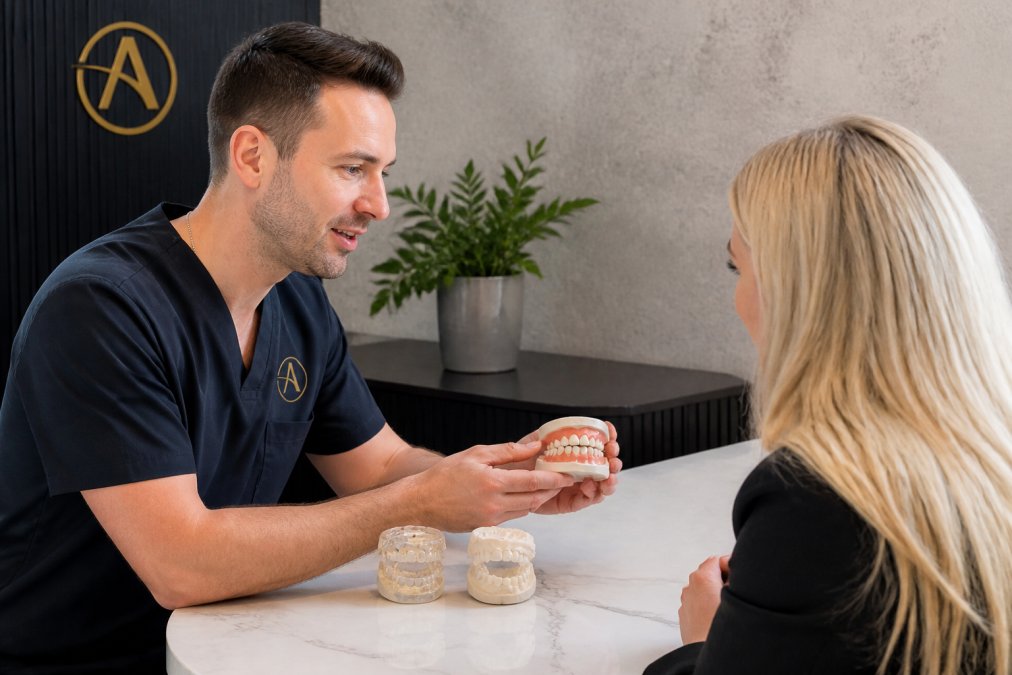
The first appointment is for diagnosis, not treatment. Your dentist should examine your teeth, gums and bite, take scans or photographs, and discuss what you want to change.
Here is where health comes before appearance. Any decay, gum inflammation or infection needs addressing first, because cosmetic work placed over active disease tends to fail. Once the foundation is sound, the design stage begins: proportions, shade and shape are planned digitally and shown to you.
Treatment, Review and Aftercare
Treatment is usually staged across several appointments, and the number depends entirely on what you are having done. Simple whitening may take one or two visits; a full reconstruction takes longer.
Aftercare is where lasting results are won or lost. Regular reviews, hygiene appointments and honest reporting of any discomfort all protect your investment. Ask upfront what happens if something needs adjusting after treatment, and get the answer in writing.
|
Stage |
What Happens |
Typical Frequency |
|---|---|---|
|
Consultation and assessment |
Examination, scans, discussion of goals |
Once |
|
Smile design |
Digital planning and preview |
Once, sometimes revised |
|
Active treatment |
Staged procedures as planned |
Varies by treatment |
|
Review |
Check healing, bite and fit |
Weeks after completion |
|
Aftercare |
Hygiene visits and monitoring |
Ongoing, usually twice yearly |
Professional Teeth Whitening and Other Cosmetic Treatments
Professional teeth whitening is a supervised process that uses clinically formulated agents to lighten the natural shade of your teeth, delivered under a dentist’s care rather than self-administered from a kit.
The distinction matters. Over-the-counter products are limited in strength, and unsupervised use can irritate gums or leave uneven results. A dentist assesses your teeth first, treats any decay, and protects the soft tissue during the procedure.
Other common treatments include:
- Composite bonding to reshape or repair chipped teeth
- Veneers for shape, colour and alignment changes
- Clear aligners to straighten teeth discreetly
- Dental implants to replace missing teeth
- Full mouth rehabilitation where multiple issues need correcting together
If your last set of veneers chipped or looked artificial, the cause is usually planning rather than the material itself. Shade selection, thickness and how the bite is managed decide whether the result looks natural.
Private Dental Care Benefits Compared With NHS Options
Private dental care means you pay directly for treatment, which gives you a wider choice of materials, techniques and appointment times. NHS dental care is delivered at set charges and prioritises clinical need, with cosmetic treatments generally not covered.
The practical differences come down to access and scope:
- Private appointments tend to be longer and available sooner
- Cosmetic treatments such as whitening and veneers sit outside NHS provision
- You choose your dentist and stay with them
- Treatment planning can account for long-term goals, not just the immediate problem
For anyone weighing up options, the NHS guidance on dental treatment charges and entitlements sets out what NHS dentistry covers. If your goal is aesthetic change, that work will almost always be private.
Why Patients Choose Aviva Cosmetic Dentistry
Aviva Cosmetic Dentistry is a fully digital private practice in the heart of St Albans, specialising in advanced restorative and implant dentistry alongside natural-looking cosmetic work.
Our clinical team includes Dr Brindha Karthikeyan, who holds a Master’s in Clinical Dentistry in Prosthodontics from King’s College London, a dentist with a special interest in cosmetic and advanced restorative dentistry, and Dr Karthikeyan Ponnusami, also holds a Master’s in Clinical Dentistry in Prosthodontics from King’s College London a dentist with a special interest in implants and advanced restorative dentistry.
What sets the practice apart is the order of operations. We identify and address any source of infection or inflammation before, during and after treatment, because healthy foundations are what make results last. Minimally invasive, biocompatible techniques and a fully digital workflow are used.
Nervous patients are a particular focus. Appointments are unhurried, assessments are thorough, and treatment happens in a calm, private setting. If you have had a difficult experience elsewhere, that history shapes how we plan your care.
Choosing a cosmetic dentist is a decision about who you trust with something people notice every day. It deserves more than a price comparison. Aviva Cosmetic Dentistry combines a clinical team, state-of-the-art digital technology and a health-first philosophy that puts prevention and biological dentistry at the centre of every treatment plan. Whether you are considering a smile makeover, dental implants or full mouth rehabilitation, the first step is an unhurried conversation about what you want and what is possible. Book your consultation now and find out what a properly planned result looks like.
Frequently Asked Questions
What should I look for when choosing a cosmetic dentist?
Check that the dentist is registered with the General Dental Council, then look at their specific training and special interests. Cosmetic dentistry is not a protected title, so any registered dentist can offer it. Ask about their experience with the treatments you want, whether they use digital planning tools, and how they handle complex cases. A thorough consultation, clear treatment plan and honest discussion of risks and maintenance are good signs. Anxious patients should also ask how the practice supports nervous patients.
Are cosmetic dental treatments covered by the NHS?
Most cosmetic treatments, including professional teeth whitening, veneers and smile makeovers, are not routinely available on the NHS because they are considered elective. NHS dental care focuses on oral health and function. Some restorative work may be partly covered if there is a clinical need, but the cosmetic element usually falls outside it. Private dental care benefits include faster access, a wider choice of materials and treatments, and more time with your dentist.
What are the benefits of choosing a private cosmetic dentist?
Private dental care benefits include shorter waiting times, longer appointments and a wider range of treatments. You can usually choose your dentist and see the same clinician throughout your care. Private practices often invest in digital scanning, 3D imaging and smile design software, which support more predictable results. You also get a personalised treatment plan built around your goals rather than a fixed NHS treatment list. Costs are agreed in advance, and you can ask for a written plan before starting.