
Table of Contents
- How to Compare Dental Implant Options: What Decides the Right Path
- Single, Multiple and Full-Arch Implants: Matching the Option to the Gap
- The Benefits of Dental Implants vs Bridges
- Dental Implant Procedure Duration: What the Timeline Actually Looks Like
- Implant Systems Compared: What the Brand Name Really Tells You
- Full Mouth Rehabilitation Options: When One Implant Is Not the Answer
- Questions to Ask Before You Commit to Any Implant Option
- Frequently Asked Questions
Last Updated: September 10, 2026
How to Compare Dental Implant Options: What Decides the Right Path
Choosing between dental implant options comes down to three variables: how many teeth are missing, the condition of the bone and gum tissue supporting them, and how the final restoration will be engineered to fit your bite. At Aviva Cosmetic Dentistry, we plan every implant case around those three questions before a single component is selected. Getting them right ensures the implant system, the timeline and the cost align with your needs. Conversely, misjudging these factors can lead to an implant failing to deliver a stable, natural-looking result. Below, we break down each decision so you can walk into a consultation knowing exactly what to ask.
General Dental Council guidance for patients is a useful starting point for checking that any clinician you see is registered and in good standing.
The Three Decisions That Shape Every Implant Plan
Dental implant treatment is the process of placing a titanium or ceramic root into the jawbone to support a crown, bridge or full arch of teeth. Around that definition sit three practical decisions:
- How many implants are needed. A single gap takes one implant. A full arch can be supported by as few as four implants in carefully selected cases.
- What the bone will accept. Bone volume, density and any history of gum disease determine whether grafting is needed first.
- How the final teeth will be made. The restoration, not the implant, is what you see and bite on, so it should be designed before surgery.
Most disagreements between clinicians come down to the third point. A surgeon focused on placement and a prosthodontist focused on the final crown can plan two very different cases. The best outcomes happen when both plan together from the start.
Single, Multiple and Full-Arch Implants: Matching the Option to the Gap
A single implant replaces one tooth and is the most straightforward option, usually completed with a custom crown. Multiple implants replace several adjacent teeth, either as individual units or as an implant-supported bridge. Full-arch treatment replaces an entire upper or lower set of teeth, often using four to six implants to support a fixed prosthesis.
The choice is not simply about the number of missing teeth. It is about how the load will be distributed. A single implant carries its own bite force. A full arch spreads that force across every implant in the design, which is why the position and angle of each one matters so much.
The number of implants is a consequence of the engineering, not the starting point. Plan the final teeth first, then work backwards to how many implants the design actually needs.
The Benefits of Dental Implants vs Bridges
Implants and bridges both replace missing teeth, but they work differently. A bridge anchors to the neighbouring teeth, which usually means those teeth are reshaped to carry it. An implant sits in the jawbone and stands alone, so the adjacent teeth are left untouched.
The benefits of dental implants vs bridges come down to three things: bone preservation, cleaning, and lifespan. An implant stimulates the bone around it, which helps slow the ridge shrinkage that follows tooth loss. A bridge does not. Implants are cleaned individually like natural teeth, while a bridge requires threading floss beneath it. And because a bridge depends on the health of the teeth holding it, its working life is tied to theirs.
Where Bridges Still Make Sense
A bridge can be the better option when the neighbouring teeth already need crowns, when bone volume is too low for implants without grafting, or when a patient’s medical history makes surgery unsuitable. It is also typically faster to complete. That is not a compromise, it is a different set of trade-offs, and a good clinician will say so plainly rather than pushing implants as the only answer.
Dental Implant Procedure Duration: What the Timeline Actually Looks Like
Dental implant procedure duration varies by case, but most plans follow a similar shape. The surgical placement itself usually takes under an hour for a single implant. Healing before the final restoration is fitted typically runs several months, because the implant needs to integrate with the bone first.
| Stage | Typical timeframe | What happens |
|---|---|---|
| Assessment and planning | 1-2 visits | Scans, digital planning, treatment discussion |
| Implant placement | 1 appointment | Surgical placement under local anaesthetic |
| Healing and integration | Several months | Bone fuses with the implant surface |
| Final restoration | 1-2 appointments | Custom crown, bridge or arch fitted |
Some cases allow a temporary tooth on the same day as surgery, but that is a provisional measure, not the finished result. If you have a fixed date in mind, such as a wedding, the honest answer is that a single implant is often achievable in that window while a full reconstruction usually is not.
A same-day temporary crown is not the same as a completed implant. Loading a healing implant too early can compromise integration, and the failure usually shows up months later, not on the day.
Implant Systems Compared: What the Brand Name Really Tells You
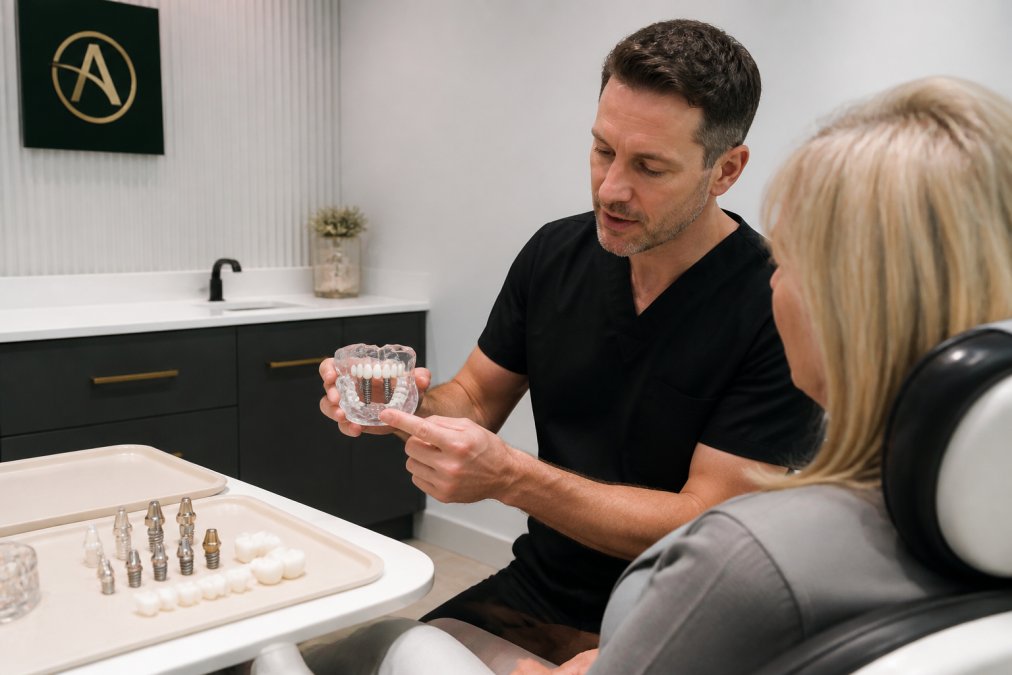
Implant systems differ in surface treatment, thread design, material and the prosthetic components they connect to. Those differences matter, but they matter less than the planning behind them. A premium system placed without proper assessment will underperform a well-chosen system placed with care.
| System | Standout feature | Best suited to |
|---|---|---|
| Straumann | SLActive surface and Roxolid material | Cases needing premium materials and long-term documentation |
| Astra Tech | Conical Seal Design and micro-threads | Preserving marginal bone and gum aesthetics |
| Hiossen | Wide range of diameters and lengths | Variable bone density and surgical flexibility |
| NeoBiotech | simplified kit for digital workflows | Efficient, digitally planned cases |
What most guides miss is that the brand name is largely a clinician’s decision, not a patient’s. What you should care about is whether the system has a documented track record and whether the practice can maintain and service it years later. Ask that question directly.
Full Mouth Rehabilitation Options: When One Implant Is Not the Answer
Full mouth rehabilitation options are for patients whose bite, wear, or tooth loss affects the whole mouth rather than a single gap. In these cases, the treatment usually combines implants, crowns, and sometimes orthodontics to rebuild the bite as a coordinated whole.
This is where treatment planning gets genuinely complex, and where being passed between specialists becomes a real risk. At Aviva Cosmetic Dentistry, full mouth rehabilitation is planned as a single case, with the digital workflow allowing the surgical and restorative stages to be designed together rather than stitched together afterwards. Our team includes Dr Karthikeyan Ponnusami, whose MClinDent in Prosthodontics from King’s College London contributes to this kind of whole-mouth planning.
Ask any practice how many full-mouth cases they complete in a year, and who plans the final bite. If the answer is vague, the coordination is probably vague too.
Questions to Ask Before You Commit to Any Implant Option
Before agreeing to any plan, get clear answers to the following. They will tell you more about the practice than any brochure.
- Who plans the final restoration, and do they meet the surgeon before surgery?
- What happens if the implant fails to integrate, and what is covered?
- How many appointments will I realistically need, and how are they scheduled?
- Is bone grafting likely, and does that change the timeline?
- What maintenance will the restoration need over the next ten years?
- Can I see examples of similar cases you have completed?
A practice that answers these without hesitation is a practice that has thought about your case properly. One that deflects is telling you something too.
You can check a clinician’s registration and any fitness-to-practise history through the General Dental Council register, and the Care Quality Commission publishes inspection findings for dental providers.
Choosing between dental implant options is not a matter of picking the most expensive system or the fastest timeline. It is about matching the plan to your bone, your bite and your life, and doing it with a team that plans the whole case rather than a single procedure. Aviva Cosmetic Dentistry brings together an internationally renowned clinical team, state-of-the-art digital technology and a tailored approach to smile design, all delivered in a calm, private setting in the heart of St Albans. Whether you need a single implant or full mouth rehabilitation, our focus is on healthy foundations, minimally invasive techniques and results that last. Book your consultation now and find out exactly which option is right for you.
Frequently Asked Questions
What are the main differences between single and full-arch dental implants?
A single implant replaces one missing tooth with its own titanium root and crown, leaving neighbouring teeth untouched. Full-arch treatment replaces an entire row, usually supported by four to six implants, and is designed for patients with widespread tooth loss or failing teeth. The clinical difference is load distribution: full-arch work spreads biting force across several implants, so bone quality, bite and gum health all need careful assessment first. Your dentist will confirm which category your case falls into after a full examination and scans.
How do dental implants compare to traditional bridges in terms of longevity?
The benefits of dental implants vs bridges come down to how each is supported. A bridge relies on the teeth either side of the gap, which must be shaped down and then carry the extra chewing load. An implant is anchored in bone in its own right, so it does not affect healthy neighbours. Bridges can work well and are often quicker to fit, but they typically need replacing sooner, and cleaning underneath them takes more effort. Your suitability for either depends on bone volume, gum health and the state of the adjacent teeth.
What factors should I consider when choosing between different implant materials?
The main choice is between titanium and ceramic (zirconia) implant components. Titanium has decades of clinical use behind it and a strong record of integrating with bone. Ceramic options are metal-free, which some patients prefer for biological or aesthetic reasons, though the evidence base is smaller. Whichever material is proposed, ask about the surface treatment, the implant’s documented success rates and how the final crown or bridge will attach. A consultation with scans will show what your bone and gum profile can support.
Are there specific health requirements for dental implant candidacy?
Good candidacy usually means healthy gums, enough bone volume to hold the implant, and any active infection or decay treated first. Conditions such as uncontrolled diabetes or a history of smoking can affect healing, so they need to be discussed honestly at assessment. Some patients need a bone graft or extra healing time before placement. There is no single pass-or-fail rule; a full examination, including scans, is the only way to know whether implants are appropriate for you.
How does a digital workflow improve the accuracy of dental implant placement?
Digital planning uses a 3D scan of your jaw to map bone density, nerve positions and the ideal implant angle before any surgery takes place. A surgical guide is then made from that plan, so the implant is placed in the pre-planned position rather than estimated during the procedure. This generally means fewer surprises, shorter appointments and a restoration that fits the planned position accurately. Ask whether your practice plans and places implants digitally, and how the final crown is matched to that plan.