
Table of Contents
- Why Busy Professionals Are Choosing Cosmetic Dentistry
- Time-Saving Cosmetic Dentistry Options for Tight Schedules
- How Professional Teeth Whitening Fits Around Your Diary
- Digital Smile Design Benefits: See the Result Before You Commit
- Understanding the Full Mouth Rehabilitation Timeline
- Cosmetic Dentistry and Your Professional Image
- Conclusion
- Frequently Asked Questions
Last Updated: September 18, 2026
Why Busy Professionals Are Choosing Cosmetic Dentistry
Cosmetic dentistry for busy professionals has moved from indulgence to practical priority. At Aviva Cosmetic Dentistry, we understand that patients want a result that looks natural rather than obviously “done”. The old assumption that cosmetic work means endless appointments, trays of impressions and months of disruption no longer holds.
What’s changed is the workflow. Digital scanning, in-house planning software and minimally invasive techniques have compressed treatment into fewer, longer appointments that can be scheduled around a working week rather than scattered across it. A single comprehensive assessment can now capture everything needed to plan whitening, alignment or a full smile makeover.
That matters because the biggest barrier for professionals isn’t cost or willingness. It’s time, and the fear of walking into a boardroom mid-treatment with temporary work on show.
The modern advantage isn’t faster treatment for its own sake. It’s fewer visits, planned in advance, with a predictable result you approve before anything permanent is done.
Time-Saving Cosmetic Dentistry Options for Tight Schedules
The most schedule-friendly treatments are those that need the fewest visits and the least recovery. Professional teeth whitening, composite bonding and clear aligner therapy are often considered for their efficiency, and each can be staged around deadlines you set.
The key is batching. Rather than six short appointments, a well-planned approach groups preparation, treatment and review into a smaller number of longer sessions. For patients commuting in and out of the area, that distinction is the difference between a treatment that happens and one that keeps getting postponed.
Treatments You Can Fit Around a Working Week
- Professional teeth whitening: often a single in-practice session, with any top-up carried out at home.
- Composite bonding: typically completed in one sitting for several teeth, with no laboratory waiting time.
- Clear aligners: planned digitally, then worn at home with periodic reviews rather than weekly visits.
- Ceramic veneers: require laboratory time, so plan for two to three appointments spaced over a few weeks.
- Dental implants and full mouth rehabilitation: staged over months, but with far fewer chairside hours than most patients expect.
A common mistake is assuming the most complex treatment automatically means the most appointments. A properly sequenced full mouth rehabilitation can be managed efficiently.
| Treatment | Typical visits | Best for |
|---|---|---|
| Professional teeth whitening | 1-2 | A fast refresh before an event |
| Composite bonding | 1-2 | Chipped or gapped front teeth |
| Clear aligners | 3-5 reviews | Crowding or spacing, worn at home |
| Ceramic veneers | 2-3 | Shape and colour changes |
| Implants or full mouth rehabilitation | Staged over months | Missing teeth, bite problems |
How Professional Teeth Whitening Fits Around Your Diary
Professional teeth whitening is a straightforward cosmetic treatment to slot into a demanding schedule. An in-practice session typically takes around an hour, and results can be more even than shop-bought kits.
The practical detail most people miss is preparation. Whitening works best on clean teeth with healthy gums, so a hygiene appointment usually comes first. If you have untreated decay or gum inflammation, whitening should wait until that’s resolved, which is exactly the kind of sequencing a proper assessment catches early.
For anyone with a fixed date in mind, work backwards. Allow a hygiene visit, the whitening session itself, and a short settling period before the event. Sensitivity varies between patients and is usually temporary, but it’s worth knowing how yours responds before a big day rather than the morning of it.
If you have a deadline, book the assessment first and the whitening second. We regularly see patients who booked whitening directly, only to discover a cracked filling or inflamed gum that had to be addressed first. That’s a fortnight lost for no reason.
Digital Smile Design Benefits: See the Result Before You Commit
The clearest benefit of digital smile design is consent you can actually give. Instead of describing a shade and a shape and hoping, you see a preview of the proposed result on your own face before any tooth is prepared.
The process starts with a digital scan rather than a putty impression, which is faster and far more comfortable for anyone with a strong gag reflex. Those scans feed into planning software where tooth shape, proportion and position are modelled against your facial features, not just your mouth. A clinician can then adjust the plan with you in the room.
This is where the professional-image question gets answered honestly. A shade that looks right on a chart can look wrong under office lighting, and a tooth length that photographs well can feel bulky in conversation. Reviewing a preview lets you say “that’s too white” or “that’s too long” while it’s still a plan rather than a permanent restoration.
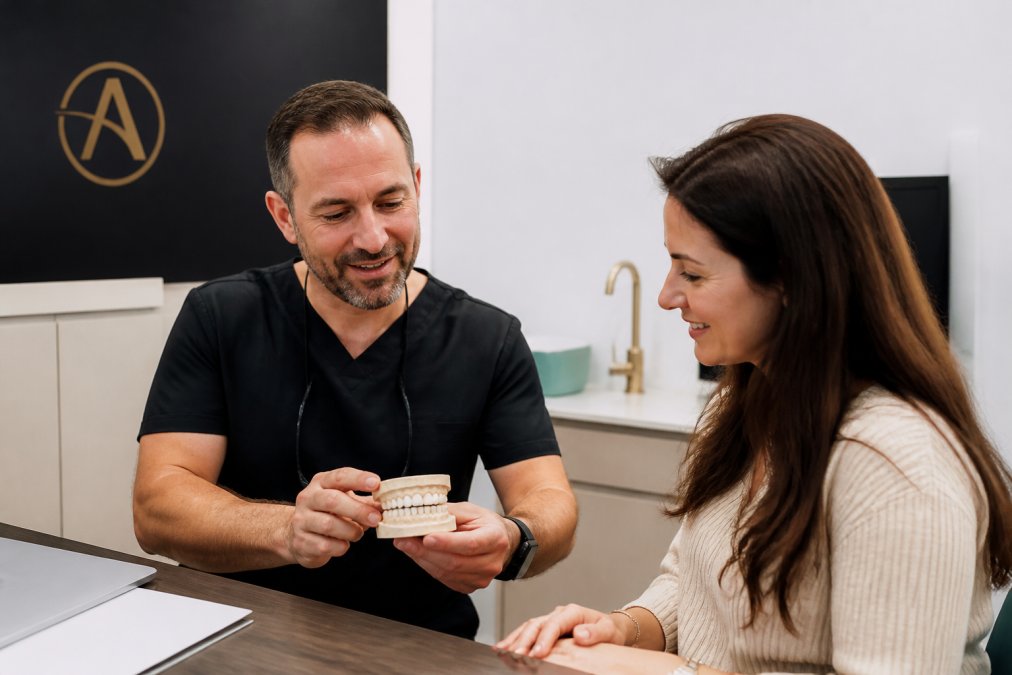
It also changes the conversation about nervousness. Patients who have had previous work they disliked often find the preview helps them feel more at ease, as it can reduce uncertainty about the process.
Understanding the Full Mouth Rehabilitation Timeline
A full mouth rehabilitation timeline is measured in months, not weeks, and it’s staged deliberately. The reason isn’t administrative slowness. It’s that healthy foundations have to be established before anything aesthetic is built on top.
The sequence usually runs like this:
- Comprehensive assessment and scans. Bite analysis, gum health, and identification of any infection or failing work.
- Stabilisation. Treating decay, gum disease or infection first. Nothing cosmetic goes ahead while active disease is present.
- Planning. Digital design, shade selection and a staged schedule agreed around your commitments.
- Rebuilding. Implants, restorations or prosthodontic work placed in planned phases.
- Review and maintenance. Checks to confirm healing, bite comfort and longevity.
Where implants are involved, healing time between placement and the final restoration is a biological requirement, not a scheduling choice. That’s the part patients most often underestimate, and it’s why an eight-month deadline for a full rehabilitation needs to be raised at the first consultation rather than the fifth.
The most common and most expensive mistake is rushing the stabilisation phase to hit a date. Placing restorations over untreated gum disease or infection is how cosmetic work fails early, and it usually costs more to correct than the original treatment.
Cosmetic Dentistry and Your Professional Image
Appearance at work is a real consideration, and it’s reasonable to treat it as one. Patients often express a desire to look healthy and well, not visibly treated. This distinction helps shape recommendations.
The genuinely useful framing is this: the goal is a smile that reads as natural under the lighting you actually work in. That means shade selection against your skin tone, tooth proportions matched to your face, and a surface texture that reflects light the way natural enamel does. Overly uniform, opaque restorations are what give cosmetic work away.
There’s also a confidence element that has nothing to do with vanity. Patients who have hidden their teeth in photographs or covered their mouth while speaking often describe a shift in how they present in meetings and on video calls. That’s a legitimate outcome, and it’s worth being honest that it’s part of why people pursue treatment.
A single well-planned intervention can often achieve significant results. A clinician who recommends a more conservative option is focused on appropriate care.
Conclusion
The real challenge with cosmetic dentistry for busy professionals isn’t finding a treatment that works. It’s finding a plan that respects your calendar, your nerves and your standards, without cutting the corners that make results last.
At Aviva Cosmetic Dentistry, we build treatment around unhurried assessment, a fully digital workflow and a preventive, health-first approach, so every stage is planned before it begins. Our internationally trained clinical team, led by Dr Brindha Karthikeyan and Dr Karthikeyan Ponnusami, combines advanced restorative and cosmetic expertise with a calm, private setting designed for patients who’ve been put off elsewhere. You see the plan, you understand the timeline, and you decide with full information.
Book your consultation now and find out what’s realistically achievable within your schedule.
Frequently Asked Questions
What are the fastest cosmetic dentistry treatments for busy professionals?
Professional teeth whitening is usually the quickest option, often needing only a short in-chair session with results visible soon afterwards. Composite bonding can reshape chipped or uneven teeth in a single visit for many cases. Both are popular with people who want a noticeable change without committing to a longer treatment plan. A consultation will confirm which option suits your teeth, since suitability depends on your oral health and goals.
How does digital dentistry reduce the number of appointments required?
Digital scanning replaces traditional impressions, so there is no putty tray and no repeat visit for a remake. Software lets your dentist plan the shape and position of your teeth in advance, and digital smile design lets you preview the result before treatment starts. That means fewer adjustment appointments and a clearer idea of the outcome, which matters when your working week leaves little room for extra trips to the practice.
Can I achieve a full smile makeover with a demanding work schedule?
Often yes, but the full mouth rehabilitation timeline varies with what your mouth needs. Straightforward cases may involve a handful of visits; more complex work involving implants or bite correction takes longer and may need healing time between stages. At a consultation your dentist can map out the stages and estimate how many appointments are realistic, so you can plan around work commitments rather than being surprised by them.
How does oral health impact long-term cosmetic dental results?
Cosmetic work lasts best on a healthy foundation. Untreated decay, gum disease or infection can undermine veneers, crowns or implants, which is why a thorough assessment comes before any aesthetic treatment. Addressing problems first, then maintaining good brushing, interdental cleaning and regular check-ups, gives your results the best chance of lasting. Your dentist can advise on a maintenance routine suited to the work you have had done.
