
Table of Contents
- Why Veneers Chip and What It Means for Your Smile
- Can Chipped Veneers Be Repaired, or Do They Need Replacing?
- Why DIY Kits for Chipped Veneers Cause More Harm Than Good
- What You’ll Need: First Aid and What to Have Ready
- Step by Step: What Happens When a Dentist Fixes a Chipped Veneer
- Dental Veneer Repair Cost UK: What Affects the Price
- Replacing a Single Dental Veneer: What to Expect
- Preventing Veneer Damage: Habits That Protect Your Smile
- Frequently Asked Questions
Last Updated: September 13, 2026
Why Veneers Chip and What It Means for Your Smile
A chipped veneer is a fracture in the thin porcelain or composite shell bonded to the front of a tooth, and it almost always signals a force the restoration was never designed to absorb. At Aviva Cosmetic Dentistry, we see this most often in patients who were never told what their veneers could and couldn’t handle. The good news: a chip rarely means the end of the restoration.
What it does mean is that you should stop chewing on that side and get the tooth assessed before the crack spreads. Porcelain doesn’t heal, and a hairline fracture that looks cosmetic today can reach the bonding layer within weeks (the NHS).
Common Causes of a Chipped Veneer
Most chips trace back to one of a handful of causes:
- Biting hard objects such as fingernails, pen lids, ice or unpopped popcorn kernels
- Bruxism, the habitual grinding and clenching that loads front teeth overnight
- Trauma from a fall, a knock or a sports impact without a mouthguard
- An uneven bite that concentrates force on one or two teeth
- Age of the restoration, as the bonding interface weakens over time
- Thin or unsupported edges where the veneer was finished too aggressively
A common mistake is assuming a chip means the veneer was badly made. More often, the bite was never balanced properly in the first place.
Can Chipped Veneers Be Repaired, or Do They Need Replacing?
Chipped veneers can sometimes be repaired with composite bonding and can sometimes only be replaced, and the deciding factor is how much structure the fracture involves. A small edge chip is a repair job. A fracture that runs through the body of the veneer, or that exposes the underlying tooth, usually means a new restoration.
When a Repair Is Possible
Repair suits a chip that is small, clean-edged and confined to the surface or the very edge of the veneer. The dentist roughens the area, rebuilds the missing section with a colour-matched composite resin, and polishes it back to the surrounding contour. It’s typically a single appointment, and the result blends well when the shade is matched carefully.
The limitation is durability. Composite repairs on porcelain don’t bond as strongly as the original veneer, so they tend to need refinishing sooner, particularly on edges that take biting force (PubMed).
When Replacement Is the Better Option
Replacement is the better route when the veneer is cracked through its thickness, when it has debonded from the tooth, when the fracture has exposed dentine, or when the chip is large enough that a composite rebuild would look patchy. If the underlying tooth is also damaged, the dentist will need to address that first.
Where several veneers are chipping in the same area, the cause is usually the bite rather than the restorations, and replacing them without correcting the bite just resets the clock.
Chewing on a chipped veneer while you wait for an appointment is how a small repair becomes a full replacement. The exposed edge is brittle, and repeated loading can propagate the crack into the tooth itself.
Why DIY Kits for Chipped Veneers Cause More Harm Than Good
DIY repair kits for chipped veneers are sold online as a quick fix, and they are one of the fastest ways to turn a repairable chip into a replacement. These kits typically contain a mouldable resin or a temporary filling material that you shape onto the tooth yourself.
The problems are practical, not just regulatory. You cannot see the fracture margins inside your own mouth, so you’re guessing at where the damage ends. The material is placed on a wet, unisolated surface, which is the single biggest reason bonds fail. And the bite is almost never adjusted afterwards, so the repair sits high and takes the full force of every chew.
What most guides miss is that a high spot on a front tooth doesn’t just break the repair. It can shift the load onto neighbouring teeth and start a chain of failures.
If a veneer comes off completely and you can’t be seen straight away, keep the piece, avoid chewing on that side, and use a dental wax or sugar-free chewing gum over the sharp edge only as a short-term comfort measure. That is first aid, not repair.
What You’ll Need: First Aid and What to Have Ready
A sensible veneer first-aid kit contains nothing exotic, and having these items ready means you can protect the tooth while you wait for an appointment:
- Sugar-free chewing gum or orthodontic wax to cover a sharp edge temporarily
- A small container with a lid to keep a detached veneer if it comes off whole
- Saline or plain warm water for gentle rinsing
- Over-the-counter pain relief if the tooth is sensitive
- A soft toothbrush and non-abrasive toothpaste
- Your dentist’s out-of-hours contact details
Do not use superglue, nail glue or any household adhesive (the NHS). These bond unpredictably, irritate gum tissue, and make the eventual professional repair considerably harder.
If a veneer detaches whole, keep it dry rather than soaking it in water. A dry veneer can often be re-bonded, and it gives your dentist a perfect colour and shape reference for a replacement if re-bonding isn’t possible.
Step by Step: What Happens When a Dentist Fixes a Chipped Veneer
A professional repair starts with assessment, not treatment, and the sequence below is the one we follow at Aviva Cosmetic Dentistry.
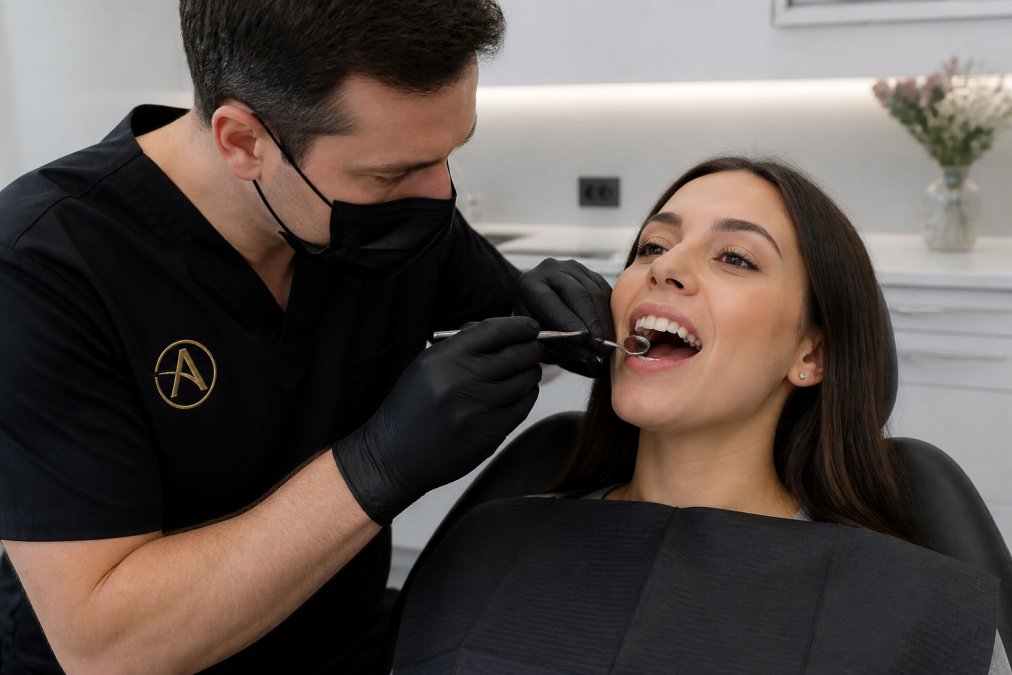
How a Dentist Assesses the Damage
The first step is working out how deep the fracture goes. The dentist examines the chip under magnification and uses a probe to check whether the edge is stable or whether it flexes. A bite analysis follows, because the position of the chip usually tells you where the opposing tooth is striking.
Digital scans and photographs record the shade, contour and bite before anything is changed. This is what makes a repair match rather than merely close.
Repair or Replacement in Practice
For a composite repair, the sequence runs like this:
- Isolate the tooth and protect the gum tissue
- Roughen and prime the fractured surface for bonding
- Build the missing section in layers with colour-matched composite
- Shape and contour to match the neighbouring teeth
- Check and adjust the bite so the repair isn’t overloaded
- Polish to match the surface texture of the original veneer
Expected result: a seamless edge that matches the surrounding veneer in shade and shape, with a bite that feels even. If the assessment shows the veneer is fractured through, the appointment shifts to planning a replacement instead.
Dental Veneer Repair Cost UK: What Affects the Price
Dental veneer repair cost in the UK varies with the type of repair, the number of teeth and the complexity of the underlying cause, and no responsible practice quotes a figure before examining you. Pricing depends on the material used, whether a replacement veneer is needed, and whether bite correction forms part of the plan.
The main factors that move the cost:
| Factor | What It Covers | Effect on Complexity |
|---|---|---|
| Repair type | Composite rebuild vs full replacement | Replacement is more involved |
| Number of teeth | Single chip vs several in one area | More teeth, more chair time |
| Underlying cause | Bite imbalance or grinding | Adds a treatment stage |
| Shade matching | Matching an existing veneer | Harder on older restorations |
| Tooth condition | Whether dentine is exposed | May need further assessment |
The honest answer is that a cheap repair that fails in six months costs more than one done properly the first time. Aviva Cosmetic Dentistry provides a written plan with costs after assessment, so you know what you’re agreeing to before treatment starts.
Replacing a Single Dental Veneer: What to Expect
Replacing a single dental veneer usually takes two appointments: one to remove the old restoration and prepare the tooth, and one to fit the new veneer. The old veneer is removed carefully to preserve as much tooth structure as possible, then the tooth is cleaned and re-scanned.
A digital scan is sent to the laboratory, and the new veneer is made to match the shade and contour of its neighbours rather than in isolation. This is the part that makes or breaks a single-veneer replacement. A veneer matched on its own can look correct in the hand and obviously wrong in the mouth.
At the fitting appointment, the dentist checks the fit, the shade and the bite before bonding permanently, then adjusts the occlusion so the new veneer isn’t carrying more load than its neighbours.
A single replaced veneer only looks invisible if it’s matched to the teeth beside it, not to a shade guide. Insist on a trial fit before permanent bonding.
Preventing Veneer Damage: Habits That Protect Your Smile
Preventing veneer damage comes down to managing force, and the habits that protect veneers are the same ones that protect natural teeth. Porcelain is strong in compression and weak against sharp, sudden impact, so the aim is to remove those impacts from your daily routine.
- Wear a custom-fitted night guard if you grind or clench
- Wear a sports mouthguard for contact sport and for cycling
- Stop using front teeth as tools for opening packaging or tearing tape
- Avoid ice, hard sweets and unpopped popcorn kernels
- Have your bite checked at routine appointments, not only when something breaks
- Keep up with hygiene visits so early debonding is caught before it becomes a fracture
For patients who’ve already had several chips, the bite is usually the missing piece of the puzzle. Correcting it is what stops the cycle.
A chipped veneer is a manageable problem when it’s assessed early, and a costly one when it’s patched at home or left to spread. Aviva Cosmetic Dentistry handles repairs and replacements with a fully digital workflow, unhurried assessment and a focus on the health of the tooth beneath the restoration, so the fix lasts rather than merely looks right on the day. Our team includes Dr Brindha Karthikeyan, a dentist with a special interest in cosmetic and advanced restorative dentistry, and Dr Karthikeyan Ponnusami, a prosthodontics specialist, and every plan is built around your bite, your goals and your timeline. Book your consultation now and get a clear, honest answer on whether your chipped veneer needs repairing or replacing.
Frequently Asked Questions
Can a chipped dental veneer be repaired, or does it need replacing?
It depends on the damage. A small chip at the edge can often be smoothed or repaired with composite resin bonded to the veneer. If the chip is large, exposes the tooth underneath, or the veneer has cracked through, replacement is usually the more reliable option. Only a dentist can assess which applies to you, so book an examination rather than guessing.
Is a chipped veneer considered a dental emergency?
Usually not, but it needs prompt attention. A sharp edge can cut your tongue or lip, and a broken veneer can leave the underlying tooth exposed to sensitivity and decay. Contact your practice for an appointment within a few days. If you have severe pain, bleeding, or the tooth itself feels loose or fractured, seek urgent dental care the same day.
How much does it cost to fix a chipped veneer in the UK?
There is no single figure. Dental veneer repair cost UK varies with the type of damage, whether the veneer can be repaired or must be remade, the material used, and the practice you attend. Private practices set their own fees. Ask your dentist for a written treatment plan and quote before any work begins so you know exactly what you are paying for.
Can I use a DIY kit to fix a chipped veneer at home?
No. DIY repair kits sold online are not a safe substitute for dental treatment. They can trap bacteria against the tooth, cause decay underneath, and damage the veneer beyond repair, turning a small fix into a full replacement. If a veneer chips, keep the area clean and see a dentist. Preventing veneer damage through good habits is far cheaper than correcting a home repair.