
Table of Contents
- Why the Full Mouth Rehabilitation Timeline Varies So Much
- Phase 1: The Full Mouth Dental Assessment Process
- Phase 2: Treatment Planning and the Digital Smile Preview
- Phase 3: Preparation and Placing the Foundation
- The Stages of Full Mouth Reconstruction: From Temps to Final
- Recovery Time After Full Mouth Rehabilitation: What Heals and When
- How Long Do Temporary Restorations Last?
- Planning Your Schedule: Working Around a Busy Life
- Frequently Asked Questions
Last Updated: September 8, 2026
Why the Full Mouth Rehabilitation Timeline Varies So Much
Full mouth rehabilitation is a complete programme of restorative and cosmetic dental work designed to rebuild the health, function and appearance of every tooth in both arches. The single most common question patients ask is how long the whole process takes, and the honest answer is that a full mouth rehabilitation timeline depends entirely on your starting point. At Aviva Cosmetic Dentistry, we plan every case around the individual, because no two mouths present the same combination of missing teeth, worn enamel, failing restorations or gum disease.
The variation comes down to three factors: the condition of your oral health, the number of teeth needing treatment, and whether any underlying infection must be resolved first. A patient with healthy gums and a few worn teeth may finish within a few months, while someone needing extractions, bone grafting and dental implants should expect a longer journey. This is not a one-size-fits-all procedure, and any practice promising a fixed duration without a thorough examination is guessing.
Phase 1: The Full Mouth Dental Assessment Process
The full mouth dental assessment process is the foundation of everything that follows, and it is where your timeline is first established. This initial stage involves a comprehensive clinical examination, digital X-rays and 3D imaging, plus a review of your bite, gum health and existing restorations. We also take the time to understand your concerns, your medical history and any anxiety you may feel about treatment, so the plan fits your needs as well as your teeth.
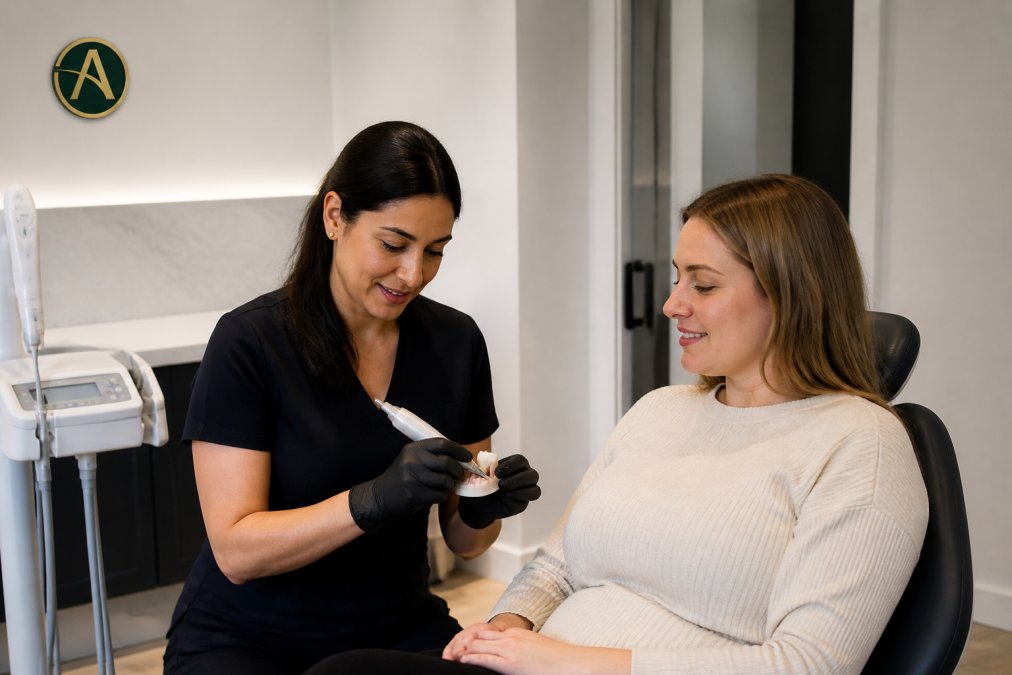
During this assessment we are checking for sources of infection or inflammation that could compromise new work. Treating active gum disease or decay before any cosmetic or restorative procedure is non-negotiable, because placing expensive restorations over an unhealthy foundation invites failure. Expect this first appointment to be unhurried and thorough, typically lasting up to an hour, and you will leave with a clearer picture of what your mouth needs.
Phase 2: Treatment Planning and the Digital Smile Preview
Once your assessment is complete, we move into detailed treatment planning, where the full mouth rehabilitation timeline starts to take shape. Using fully digital workflows, we create a precise blueprint of your target outcome, including a digital smile preview so you can see the proposed result before any treatment begins. This is your opportunity to comment on the shape, shade and size of your new smile, ensuring the final appearance looks natural rather than obviously cosmetic.
A common concern is that veneers or crowns will look too white, bulky or uniform. Modern smile design avoids this by considering your facial features, skin tone and existing teeth, so the result blends seamlessly. Your plan will also map out the sequence of treatment, the number of appointments required and the estimated duration, which is particularly valuable if you are working around a busy schedule or preparing for a significant life event.
Phase 3: Preparation and Placing the Foundation
This is where the physical work begins, and it is the stage that most influences your overall recovery time after full mouth rehabilitation. Preparation involves stabilising your oral health first: treating any gum disease, extracting teeth that cannot be saved and placing dental implants where teeth are missing. Bone grafting may be necessary if there is insufficient jawbone to support implants, and this requires healing time before implants can be placed (aaoms.org).
Healthy gums are the foundation of lasting results. We place a strong emphasis on biological dentistry, working to eliminate any source of infection or inflammation before, during and after your treatment. Depending on the complexity of your case, this foundation phase can take anywhere from a few weeks to several months, particularly if implant placement and osseointegration, the process where bone fuses to the implant, are involved.
The Stages of Full Mouth Reconstruction: From Temps to Final
The stages of full mouth reconstruction follow a logical sequence that protects your investment and lets you adjust to your new smile gradually. After any extractions or implant surgery, temporary restorations are fitted so you can eat, speak and smile normally while your mouth heals. These temporaries also allow us to refine the shape and bite before the final restorations are crafted.
Once your gums have healed and implants have integrated, we move to the fitting of your permanent restorations. These may include crowns, bridges, veneers or implant-supported teeth, each crafted to match your digital smile preview precisely. You will try them in, we will check your bite and make any micro-adjustments, and only when everything feels comfortable and looks right will they be cemented or screwed into place. The final stage is a review appointment to confirm your bite is stable and you are happy with the result.
Recovery Time After Full Mouth Rehabilitation: What Heals and When
Recovery time after full mouth rehabilitation is not a single period but a series of healing phases that follow each procedure. After extractions, most discomfort settles within a few days, though the socket continues to heal for several weeks (the CDC). Implant placement typically involves minor soreness for two to three days, while the underlying bone needs several months to integrate fully with the implant before final teeth are attached (the American Dental Association).
| Treatment Stage | Typical Healing Focus | What You Can Expect |
|---|---|---|
| Extractions | Socket closure | Discomfort eases in days; soft diet advised |
| Gum treatment | Tissue reattachment | Tenderness for one to two weeks |
| Implant placement | Bone integration | Soreness for days; integration over months |
| Final restorations | Bite adjustment | Minor sensitivity as you adapt |
During each phase you will be given clear aftercare instructions, and we are always available if you have concerns. Most patients manage their normal routines within a day or two of treatment, though you should plan lighter activity around surgical procedures.
How Long Do Temporary Restorations Last?
Temporary restorations are designed to last for the duration of your treatment, which is typically a few weeks to several months. They are not as strong as your final teeth, so you will need to be mindful of what you eat, avoiding very hard or sticky foods that could dislodge them. We craft each temporary to fit comfortably and look acceptable, because you will be wearing them while your gums heal and your smile settles.
The lifespan of a temporary is deliberately shorter than a permanent restoration, and that is the point. Temporaries allow your gum tissue to heal into a stable contour and let us test the aesthetics and bite before committing to the final work. If a temporary does come loose, contact the practice promptly, as it is protecting the healing tissues beneath it.
Planning Your Schedule: Working Around a Busy Life
For professionals and commuters, the practical question is how many appointments a full mouth rehabilitation requires and whether treatment fits around a demanding timetable. The answer depends on your case, but a well-structured plan groups procedures efficiently to minimise visits. Some stages can be combined, and digital planning reduces the need for repeated appointments.
If you are preparing for a wedding or another key event, be realistic about the timeline and start early. Complex cases involving implants can span many months, so beginning your journey well ahead of the date gives you the best chance of finishing comfortably. During your consultation we will map out a schedule that works for you, and we are happy to discuss how we can accommodate your commitments while delivering the standard of care your smile deserves.
A full mouth rehabilitation timeline is rarely short, but it is always structured and predictable when planned properly. The key is to start with a thorough assessment so you know exactly what your mouth needs and how long it will take. At Aviva Cosmetic Dentistry, our internationally renowned team combines advanced restorative dentistry with a fully digital workflow, so you receive precise, comfortable care in a calm, private setting. Book your consultation now and take the first step towards a healthy, confident smile built to last.
Frequently Asked Questions
How long does a full mouth rehabilitation take on average?
A full mouth rehabilitation is rarely quick. On average, the full mouth rehabilitation timeline spans from 6 to 18 months, though complex cases can take longer. This depends heavily on your specific needs: whether you require extractions, bone grafting, or dental implants, as well as the number of appointments needed for your final restorations. A thorough initial assessment will give you a personalised timeline. The goal is to ensure a healthy foundation for lasting results, which takes precedence over speed.
What are the main stages of full mouth reconstruction?
The stages of full mouth reconstruction typically follow a predictable sequence. It begins with a comprehensive full mouth dental assessment process, including 3D imaging and digital scans. Next is detailed treatment planning, where your dentist maps out the final result. The active treatment phase follows, which can involve extractions, periodontal therapy, implant placement, and provision of temporary restorations. Finally, the permanent, custom-crafted teeth are fitted and fine-tuned, completing your new smile.
Is full mouth rehabilitation painful?
Modern dentistry is designed to be as comfortable as possible. During procedures, local anaesthetic ensures you feel no pain. After treatment, you can expect some soreness, swelling, or discomfort, which is a normal part of the recovery time after full mouth rehabilitation. Your dental team will provide clear guidance on managing this with over-the-counter pain relief. The practice also takes a gentle, patient-focused approach, which is particularly helpful for those who feel anxious about dental work.
How long do temporary restorations last during treatment?
Temporary restorations are built to be functional but not permanent. They typically last anywhere from a few weeks to several months, serving as a protective and aesthetic placeholder while your gums heal and your permanent teeth are being crafted in a dental laboratory. While they allow you to eat and speak normally, they are more prone to chipping than final restorations. Your dentist will advise you on how to care for them during this phase of your full mouth rehabilitation.
What factors can extend the duration of my dental reconstruction?
Several factors can lengthen the stages of full mouth reconstruction. The most common is the need for bone grafting or sinus lifts to create a solid foundation for dental implants, which adds several months of healing time. Treating advanced gum disease before any restorative work is another essential step that can extend the timeline. Also, the choice of materials and the complexity of your bite correction will influence how long the laboratory needs to perfect your final restorations.
Can I have a full mouth rehabilitation if I am a nervous patient?
Yes. A significant part of the full mouth dental assessment process is understanding your concerns. Many practices, including those focused on high-end restorative care, are experienced in treating anxious patients. They achieve this through an unhurried, communicative approach, explaining each step and working at a pace you are comfortable with. The use of fully digital workflows also means fewer and shorter appointments, which can make the entire full mouth rehabilitation timeline feel far less daunting.
